
Good horse care is mostly repetition. The same handful of jobs, done every day and roughly in the same order, keep a horse's gut moving, its feet sound and its skin clear. They also give whoever does them a daily look at the animal: a swelling that was not there yesterday, a hay pile left untouched, a hoof with a smell it should not have. Below is the core routine of feeding, water, grooming and hoof care, then the shelter, turnout and professional visits that sit around it, with notes on the long, wet Fraser Valley winters that make mud a constant theme in Langley and Aldergrove barns.
What every horse needs, every day
Strip horse care down and five things remain: forage, water, shelter, room to move and the company of other horses. Everything else, from brushes to blankets, supports those five. An animal can live without a fancy barn, but not without hay or pasture in front of it for much of the day, or without clean water it is willing to drink.
Canada has a national reference for these basics. The Code of Practice for the Care and Handling of Equines, published by the National Farm Animal Care Council in 2013, separates firm requirements from recommended practices. A revised edition went through public comment in early 2026, so check the NFACC page for the current version. It is written for owners and principal caregivers alike, which includes anyone keeping a horse at home and the staff of a boarding barn, and it treats the overall welfare of the animal as the owner's responsibility even when someone else does the daily chores.
Feeding: forage first
The equine digestive system evolved to process small amounts of fibrous plants for most of the day. Given the choice, horses spend around 12 hours a day eating and do not voluntarily go more than three or four hours without food. Their stomachs are small, and long empty spells have been linked to gastric ulcers and to habits like cribbing. That is the reasoning behind every feeding rule that follows: the closer a routine comes to those natural feeding patterns, the fewer digestive health issues it tends to cause.
How much hay or pasture
A mature animal at maintenance eats roughly 1.5 to 2% of its body weight in feed per day, and forage should make up most of the horse's diet. For a 500 kg horse, that works out to about 7.5 to 10 kg of hay a day, less if it is grazing good pasture. An average 1,100-pound horse living on hay alone, in other words, goes through about 16.5 to 22 pounds of hay daily. Some guides allow up to 2.5% for hard keepers.
When measuring feed, weight matters more than flakes. A flake from one bale can weigh twice as much as a flake from another, so many horse owners put a few on a scale once and note what a normal ration looks like. Horses that bolt their hay, or that put on weight easily, often do better with a slow-feeder net, which stretches the same ration over more hours. Pasture changes through the year, too: lush spring grass may replace much of the hay, while winter and dry spells call for more of it.
The quality check before feeding is simple. Hay should smell sweet, be free of visible mould and carry little dust. Coastal humidity makes mould a real risk in stored bales, so open a few from each load and keep the stack off the floor.
Grain, concentrates and salt
Many pleasure and trail horses need no grain at all. Concentrates exist to supply energy that forage cannot, for example for a horse in heavy work, a growing youngster or an older animal that struggles to chew hay. Too much grain can lead to obesity, digestive upset and laminitis, which is why a balanced diet starts from the hay and adds only what is missing.
If you do feed grain or other concentrates, split the ration into at least two meals, and make any increase gradually, over about a week to ten days; switching to a new type of feed works the same way. Horses' digestive systems cope poorly with big starchy meals, and sudden changes are a known trigger for colic. Salt is not optional: every horse should get it, either in the ration or through free access to a block or loose salt. The right amounts for an individual are a question for a veterinarian or equine nutritionist, who can also say whether local hay is short on any minerals and how the horse's health needs change with age and exercise level.
Timing and routine
Horses thrive on routine, and a feeding schedule that moves around from day to day can unsettle a colic-prone animal. Feed at consistent times and offer forage before any grain. A full gut and hard work do not mix, so ride well after a meal, and let a sweating animal cool off and breathe normally before it eats.
Clean water, in every season
Water is the single most important nutrient, and horses can be fussy about it. If it tastes off, is dirty or comes from an unfamiliar source, many simply drink less, and that raises the risk of impaction colic, a serious health emergency. Horses need constant access to clean water, and a practical floor is worth knowing: in mild weather, between 5°C and 20°C, a resting animal needs at least 5 litres per 100 kg of body weight a day, and intake rises with heat, humidity, exercise and lactation. A typical horse drinks somewhere between about 19 and 57 litres, which is roughly 5 to 15 gallons of water.
Scrub buckets and troughs on a regular schedule. Automatic waterers need a daily look to confirm they are actually flowing, and it is worth testing for stray voltage, since a horse that gets a small shock while drinking may stop using the bowl altogether.
Winter adds two problems. Ice can seal off a horse's water source overnight, and snow is not a substitute: eating it will not meet a horse's needs. In cold weather, slightly warmed water encourages drinking, which matters because a horse that drinks less also tends to eat less hay just when it needs extra calories.
A daily grooming routine
In daily horse care, brushing is less about shine than about inspection. Working over the whole body every day puts your hands on every leg and every patch of skin, so cuts, heat, ticks and sore spots get found early, and skin health problems are caught before they spread. It also loosens mud that, left on, can irritate the skin and flatten the coat so it insulates poorly.
A basic kit covers most of it:
- Rubber curry comb, worked in small circles on the muscled areas to lift dirt and loose hair. Skip the bony legs and face.
- Stiff dandy brush, used in short flicks to send that dirt off the coat, plus the legs if they are caked.
- Soft body brush for the finish and for the face, and a damp cloth around the eyes and nostrils.
- Mane and tail comb, or fingers and a detangler, worked from the ends upward to save hair.
- Hoof pick, covered in the next section.
One part is a requirement rather than a nicety. The horse's saddle and girth areas must be free of dirt and debris before tack goes on, and the underside of the tack should be clean too. Grit under a saddle pad can rub a sore in a single ride. Burrs and burdock tangled in the mane or tail need to come out as soon as you find them.
Fraser Valley horses often come in wet. Brushing a soaked coat smears mud into the skin, so let the horse's coat dry under a cooler or in the stall first, and keep an eye on the lower legs, where constant damp can lead to scabby, sore skin around the heels. If you blanket, take the blanket off and look at the body underneath; the national code requires that at least once a week, and many owners do it daily.
Hoof care between farrier visits
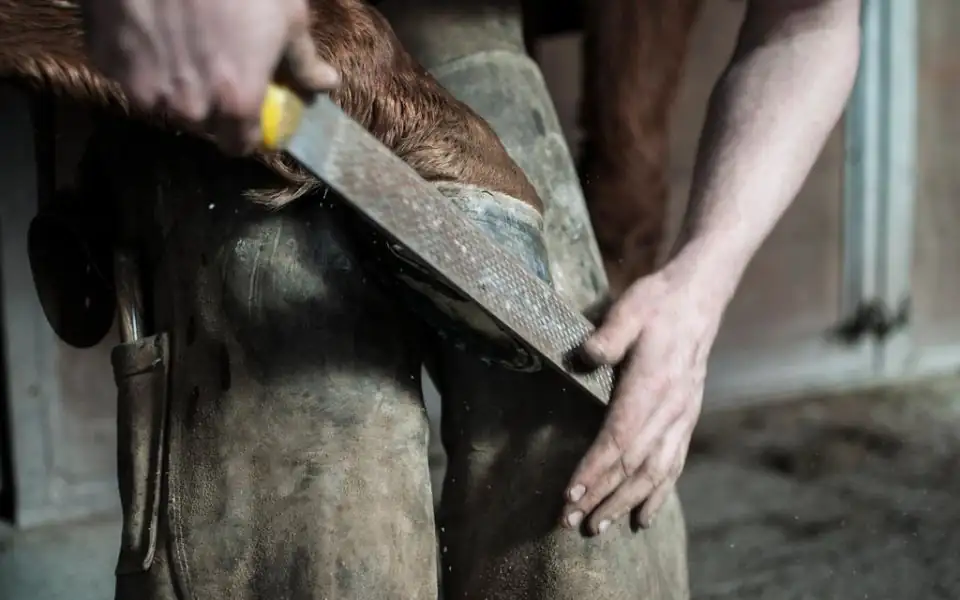
A horse's hooves grow continuously, a little like fingernails, and an untrimmed foot becomes unbalanced and strains the structures above it. That is why regular farrier visits set the calendar. Many owners book on a six to eight week cycle. The national code suggests trimming or resetting shoes every five to eight weeks, depending on age, workload, nutrition and breed, and a farrier may shorten that interval for problem feet.
Not every horse needs shoes. They are used when wear exceeds growth, or to correct gait or conformation, and many pleasure horses go barefoot, sometimes with hoof boots for rocky trails. Whatever the arrangement, the rule is the same: feet must not be allowed to grow long enough to cause pain or injury.
Your share of hoof care is daily and quick. Pick out the horse's feet, ideally once a day and always before a ride, working from heel to toe and paying attention to the grooves either side of the frog. While the foot is up, look and smell for:
- stones or nails lodged in the sole;
- a black, putty-like discharge with a foul odour around the frog, the classic sign of thrush;
- new cracks, or a shoe that has shifted or has risen nails;
- heat in the hoof wall, or a strong pulse at the back of the fetlock, both reasons to call the vet.
Thrush is a bacterial and fungal infection that thrives in wet, dirty footing, which is exactly what a rainy coastal winter produces. Cleaning lets air into the grooves, and dry bedding plus a mud-free place to stand do the rest. For a case that keeps returning, ask the farrier or veterinarian rather than reaching for another bottle from the tack shop.
Shelter, turnout and company
On the coast, wind-driven rain is a bigger problem than frost. The code requires a safe shelter that protects horses from wind, wet and summer sun: a barn, or a solid three-sided run-in shed facing away from the prevailing weather. If the shed stands empty in inclement weather, it may be too small or badly placed. Indoors, airflow matters more than warmth: ammonia and hay dust build up in a closed barn and irritate the airways, so keep vents open and blanket a cold animal instead.
Good horse care in this climate is largely about mud and shelter. Under the code, horses kept in muddy conditions must have access to a well-drained, mud-free area where they can stand and lie down. Gravelled pads around gates, waterers and hay feeders, and a sacrifice paddock that lets the grass rest over winter, are two common ways to meet that rule on wet ground.
Turnout is not a luxury either. A paddock or pasture lets the animal move, which is gentle exercise in itself and supports bones, tendons and digestive health. The code requires exercise or turnout for horses in stalls, except on medical rest. Where turnout is limited, regular exercise by hand walking, lunging or riding fills some of the gap. Fencing must be strong, well maintained and safe; barbed wire has no place around horses.
Finally, horses are herd animals. One kept alone tends to be stressed, so it should at least be able to see, hear and smell others. If a second horse is not possible, the code suggests more human contact or another grazing species, such as sheep, though any companion brings care needs of its own.
Veterinary care, teeth and parasites
A sound working relationship with an equine veterinarian is part of routine horse care, not an emergency expense. A routine visit while the animal is healthy is the time to agree on a written care plan for vaccines, parasites and teeth. Regular veterinary care catches problems a horse owner may not see until they are advanced.
Vaccination needs depend on where a horse lives and travels, so the list is the vet's call. Tetanus is on nearly every schedule. The core vaccines recommended by the American Association of Equine Practitioners (AAEP) also include eastern and western equine encephalomyelitis, West Nile virus and rabies, and competition horses usually need influenza and herpesvirus as well.
Parasite control has changed in recent years because worms have become resistant to common dewormers. Rather than deworming everyone on a fixed calendar, many vets now use fecal egg counts to decide which animals need treatment and when. Heavy loads of internal parasites can cause weight loss and colic, so a plan is a requirement, not an extra.
Routine dental care is the other piece. A horse's teeth keep erupting for much of its life and can wear into sharp points, so they should be examined at least annually and floated as needed, by a veterinarian or someone working under direct veterinary supervision. Good dental care also protects digestion, since poorly chewed feed is harder on the digestive system. Watch for these signs of dental trouble:
- dropping half-chewed feed, known as quidding;
- eating slowly, or tilting the head while chewing;
- long fibres in the manure, or weight loss without a clear reason;
- fighting the bit, drooling, or a bad smell from the mouth or nostrils.
Ask the vet how to take a temperature, pulse and breathing rate, and note your horse's resting figures. Those numbers make a phone call to the vet far more useful when something does go wrong, and they are one of the simplest records of the horse's health you can keep.
A simple daily horse care checklist
Whether you keep a horse at home or visit one at a boarding barn, the daily list looks much the same:
- Look at the horse's posture, appetite and manure before you touch it, and watch for lameness.
- Confirm that water is clean, flowing and unfrozen.
- Feed forage on schedule, then any concentrate, and note what was left from the last meal.
- Muck out stalls, pick manure from paddocks and pasture, and keep bedding dry.
- Walk the fence line and shelter after wind for broken rails and blown debris.
- Groom, paying attention to the saddle area and lower legs.
- Pick out all four feet and look for thrush, stones and loose shoes.
- Provide turnout or exercise, and look under blankets.
None of it takes long once it becomes habit, and the habit is the point. Daily attention is what turns small changes into early warnings rather than vet bills. Horse owners who board can learn a great deal by watching experienced staff handle these jobs. If you plan to provide your horse with care at home, line up a vet and a farrier before the horse arrives, not after the first problem.
