
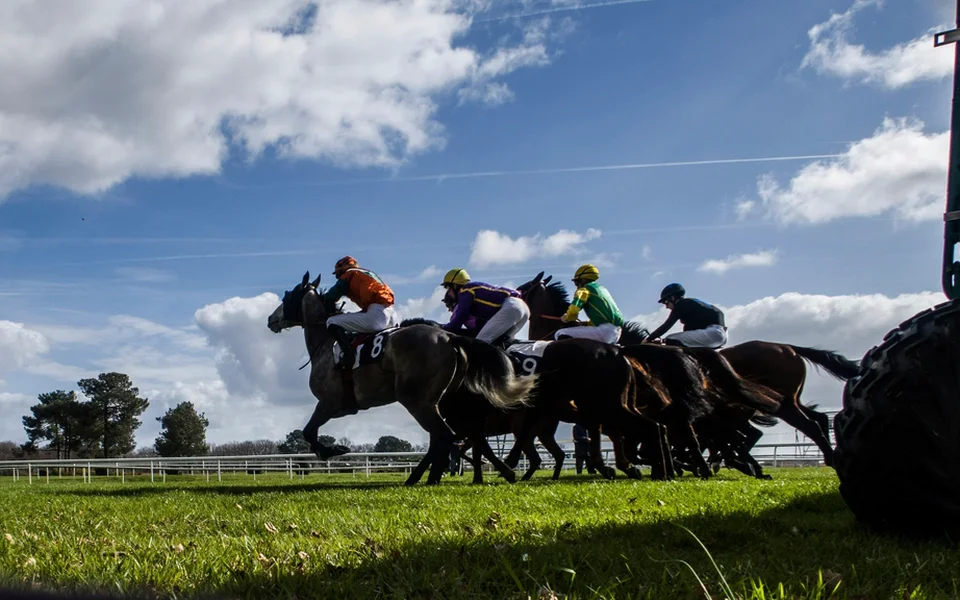
Open the lobby of an online casino such as spinempire casino and horses turn up on the reels again and again: galloping stallions, jockeys in bright silks, horseshoes, trophies. Horse-themed slots borrow their look from the racetrack and the open range, yet the artwork has nothing to do with how a game pays. Read from the barn side, those pictures are a mixed bag. Some details are faithful to real horses, some repeat mistakes that painters made two centuries ago, and none of them change the arithmetic underneath.
Why horses keep landing on the reels
Game studios reach for horses for the same reason carousel makers and whisky labels do. The animal is instantly readable, it carries a sense of speed, and it comes with a ready-made set of props. Two families of horse slots have grown out of that.
The first is the race-day game. Its symbols come from the grandstand: numbered saddle cloths, jockey caps, binoculars, a winner's cup, a betting slip. The second family leaves the track altogether and heads for open country, with wild herds, a lone stallion on a ridge, canyon sunsets and a western soundtrack.
Then there is the horseshoe, which turns up in both. As a good-luck charm it is far older than any casino, and folk tradition in many countries still has people nailing one over a door. Slot designers did not invent the link between horses and luck. They inherited it.
What a theme changes, and what it leaves alone
Strip away the artwork and a horse slot is built like any other. Symbols sit on reels and rows, and a payout follows when matching symbols line up along a payline or in one of a set number of "ways". A wild stands in for other symbols. A scatter triggers a feature wherever it lands. Free spins, multipliers, cascades that clear winning symbols and drop new ones in, and wheel-style bonus rounds are common to every theme.
The outcome of each spin comes from a random number generator. Every spin is independent of the last, so a game cannot be "due", and stopping the reels sooner or later does nothing to the result.
Each title also has a published return to player, or RTP, which for well-known racing-themed games commonly sits in the mid-90s per cent. That number describes the average over an enormous count of spins, with the remainder kept by the house. It says nothing about a single evening.
So the theme decides what the symbols look like and what the bonus round is called. It does not touch the odds.
The gallop, drawn right and drawn wrong
Here a rider's eye starts to catch things. For centuries artists painted galloping horses with all four legs flung out, front legs forward and hind legs back, like a rocking horse in mid-air. Nobody could see otherwise, because the stride is too fast.
In June 1878 the photographer Eadweard Muybridge settled the matter at Leland Stanford's track in Palo Alto, California. A row of cameras caught a mare called Sallie Gardner frame by frame, and the series, held today by the Library of Congress as The Horse in Motion, showed that a galloping horse does leave the ground completely. It does so when the legs are gathered under the body, not when they are stretched out.
The gallop is a four-beat gait: each hoof strikes separately, followed by that brief moment of suspension. The canter, its slower relative, has three beats. Plenty of slot artwork still uses the old rocking-horse pose, because it reads as speed at a glance. The games that look most convincing to horse people are usually the ones drawn from photographs.
Coat colours and breeds on the paytable
Higher-paying symbols are often individual horses, told apart by colour. The usual cast is easy to name in stable terms:
- Bay – a brown body with black mane, tail and lower legs. Very common on real racetracks.
- Chestnut – reddish all over, with a mane and tail the same shade or lighter and no black points.
- Black – the dramatic choice for a top symbol, and rarer in life than on screen.
- Palomino – a gold coat with a pale mane and tail, a favourite of western-themed games.
The "white stallion" deserves a note. Most white-looking horses are greys: they are born a darker colour and lighten year by year, while the skin under the coat stays dark. A dazzling white horse leading a wild herd is therefore, more often than not, an older grey.
Breed is looser still. Race-day games draw a lean, long-legged Thoroughbred type. Desert and fantasy themes lean on the Arabian, recognizable by a dished face and a tail carried high. Open-range games show "wild mustangs", which in reality are free-roaming horses descended from domestic stock, and they tend to be smaller and plainer than the glossy animals on the reels.
Silks, saddles and other details from the track
Racing symbols hold up better, partly because the real objects are already so graphic. The colours a jockey wears are called silks, and they belong to the horse's owner, not the rider; a jockey changes silks from race to race depending on who owns the mount. A game that gives each horse its own colours is closer to the truth than one that gives each jockey a signature outfit.
A racing saddle is tiny compared with the general-purpose saddle used in a riding lesson, and the stirrups are set short so that the jockey balances over the horse's shoulders. Racehorses wear light aluminium shoes known as racing plates, not the heavy steel horseshoe of the lucky-charm symbol. In North America flat races run counter-clockwise, a detail the better-drawn track backgrounds get right. For the real history behind those backgrounds closer to home, see the article on horse racing in British Columbia.
Where the comparison ends
Knowing horses helps at a real stable. It helps a rider choose a suitable mount, read a pinned ear, or judge whether a horse is moving soundly. It does nothing on a slot.
That holds even for bonus rounds that ask the player to pick a horse and watch a short animated race. The choice feels like handicapping, but the finishing order comes from the same random number generator as every spin. No horse on the screen has form, fitness or a bad day.
Seen that way, a horse slot is a piece of themed entertainment with a price, the same as a cinema ticket. Time around real horses offers something else: a skill that builds with practice.
Keeping it within limits in BC
In British Columbia, anyone under 19 is prohibited from taking part in commercial gambling. For adults who do play, the plain habits are the useful ones: decide on an amount and a length of time beforehand, treat the money as spent, and stop when either limit is reached. No theme, bonus feature or betting pattern guarantees a win.
The provincial government's Gambling Support BC service provides free information, counselling and a 24-hour support line for anyone worried about their own gambling or that of someone close to them.
